


Compliance Management Software: What It Is and How to Choose the Right Platform
Anna Fitzgerald
Senior Content Marketing Manager
Emily Bonnie
Senior Content Marketing Manager
Compliance software can replace spreadsheets, screenshots, and disconnected workflows with a centralized way to manage requirements, controls, evidence, policies, risks, and audits. But the category is broad: some platforms focus on security compliance automation, while others support enterprise governance, risk, and compliance or specialized regulatory needs.
Choosing the right type of platform starts with understanding what you need to manage, which processes you want to automate, and how the software will fit into your existing technology and compliance program.
This guide explains how compliance management software works, the categories and capabilities to consider, and how to evaluate the right solution for your organization.
The challenges of managing compliance manually
Many businesses still rely on spreadsheets, documents, screenshots, and manual processes to manage compliance. This approach becomes harder to sustain as the organization, regulatory landscape, and compliance program grow.
- Audit fatigue: Organizations that manually manage compliance often experience audit fatigue. Preparing for audits requires extensive documentation gathering, organizing policies, and responding to auditor requests, which places a heavy burden on compliance teams. This repetitive and time-consuming process can lead to employee burnout and inefficiencies in operations.
- Human error: Manual compliance processes are prone to human error. Data entry mistakes, misplaced documents, and overlooked compliance tasks can lead to compliance risks and violations. Without automation, businesses must rely on their teams to track all compliance requirements manually, increasing the likelihood of costly mistakes.
- Inefficiency: Managing compliance manually consumes significant time and resources. Employees must track regulatory and framework updates, document security measures, and ensure all compliance requirements are met without the help of automation. This inefficiency diverts valuable resources away from core business operations, affecting productivity and growth and their security and compliance posture.
- Lack of real-time visibility: Without a centralized compliance platform, businesses struggle to gain real-time visibility into their compliance status. Tracking compliance progress across multiple teams and departments becomes a challenge, leading to delayed responses to potential compliance issues and increased risks.
- Difficulty in scaling: As businesses grow and the regulatory landscape evolves, maintaining compliance through manual processes becomes increasingly difficult. Expanding operations across multiple regions or industries adds complexity to compliance management, making it harder to track different regulatory requirements and enforce consistent policies.
Recommended reading

Why Bruin Chose Compliance Automation to Reduce Human Error
What is compliance management software?
Compliance management software is a digital platform that helps organizations track, manage, and maintain compliance with applicable regulations, standards, and security frameworks. It centralizes requirements, controls, evidence, policies, tests, risks, tasks, and audit records so teams can manage their compliance program in one place.
Modern compliance software can also automate evidence collection, test controls continuously, identify gaps, assign remediation work, and generate reports for auditors and other stakeholders. This helps organizations move from periodic, point-in-time compliance projects toward a more continuous approach.
Compliance management software is commonly used by security, compliance, risk, IT, and internal audit teams. It can support programs involving frameworks and standards such as:
By using a dedicated compliance management tool, companies can efficiently manage regulatory requirements, reduce risks, and maintain audit readiness.
Recommended reading

5 Hardest Things About Security Compliance and How Technology Can Help
What types of compliance software are available?
“Compliance software” can describe several categories of products. Understanding the differences can help you avoid buying a platform designed for a different compliance problem.
| Category | Primary purpose | Common use cases |
|---|---|---|
| Security compliance automation | Automate framework readiness, control monitoring, evidence collection, and audit preparation | SOC 2, ISO 27001, PCI DSS, CMMC, and other security or privacy programs |
| Compliance management systems | Coordinate requirements, controls, policies, issues, documentation, and reporting | Multi-framework programs, policy management, control ownership, and compliance reporting |
| Enterprise GRC platforms | Connect governance, enterprise risk, internal audit, policy, and compliance activities | Complex organizations with broad risk aggregation, internal audit, and governance requirements |
| Specialized compliance tools | Manage a particular regulatory or operational domain | Regulatory change, financial crime, environmental compliance, quality management, or industry-specific obligations |
These categories overlap. For example, a security compliance automation platform may also include risk management, vendor management, policy workflows, and other GRC capabilities. The important question is not what category label a vendor uses, but whether the platform supports your required workflows in enough depth.
How compliance management software works
Compliance management software centralizes program data and uses integrations, automated workflows, and continuous monitoring to reduce manual work. A typical process includes the following steps.
1. Select frameworks and map controls
Organizations begin by selecting the regulations, standards, or frameworks they need to address. The platform maps requirements to controls and tests, reducing the need to interpret and organize every requirement manually.
Platforms that support common controls can map one control and its evidence to multiple frameworks. This helps teams avoid repeating the same work across overlapping requirements.
2. Connect systems and collect evidence
Compliance software integrates with cloud services, identity providers, HR platforms, security tools, and other systems that contain compliance data. These connections can automatically collect evidence, such as system configurations, access records, device settings, training completion, and policy acknowledgments.
The depth of an integration matters. Buyers should determine whether an integration collects and tests audit-relevant configuration data or simply confirms that a system is connected.
3. Monitor controls and identify gaps
Compliance management software can monitor security controls continuously and alert teams when tests fail or configurations drift out of compliance. This provides a more current view of control health than periodic spreadsheet reviews.
Some platforms also perform automated gap analyses, helping teams understand which requirements are incomplete and what work is needed to address them.
4. Assess risk and manage remediation
Compliance software can support risk assessments, risk scoring, treatment decisions, and mitigation tracking. When the platform identifies a failed test or control gap, teams can assign owners, create tasks, and monitor the remediation process.
This creates a traceable connection between identified issues and the work performed to address them.
5. Manage policies and documentation
A centralized platform helps teams create, distribute, update, and manage compliance-related documents. It can also track approvals and employee acknowledgments, making it easier to demonstrate that required policies are current and communicated.
6. Manage third-party risk
Organizations rely on vendors, contractors, partners, open-source projects, and other third parties. Compliance software can support vendor risk management by centralizing reviews, tracking findings, assigning risk owners, and maintaining current vendor risk profiles.
These workflows can help organizations address third-party security and understand how external relationships affect their compliance and risk posture.
7. Coordinate personnel compliance
Employees play an important role in maintaining compliance. A compliance platform can distribute security training and policies, track completion and acknowledgments, and monitor personnel-related requirements. This reduces manual follow-up and creates a central record for audits.
8. Prepare for and manage audits
Preparing for and managing audits becomes easier when controls, evidence, policies, risks, and activity records are organized in one system. Teams can respond to evidence requests, share documentation with auditors, and monitor audit progress without rebuilding the program record for each assessment.
Recommended reading
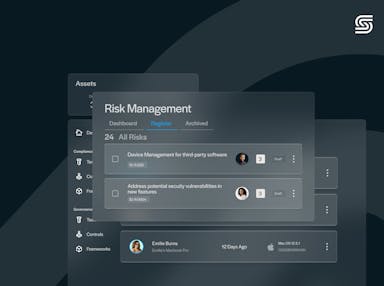
What Is GRC Software and How Does It Work?
Benefits of compliance management software
Compliance management software can provide significant advantages over manual processes, particularly as a company adds frameworks, systems, and stakeholders.
We surveyed more than 160 small businesses to measure the impact of a compliance management solution, gathering data on cost savings, efficiency gains, and total ROI. Below, we dive into the biggest benefits these businesses have experienced from implementing compliance management software.

1. Saves time
Automation eliminates time-consuming manual tasks, allowing compliance and security teams to focus on higher-value activities. By streamlining compliance processes, organizations can improve operational efficiency and reduce administrative burdens.
On average, organizations report saving 6 hours per week on security and compliance tasks since implementing Secureframe.
2. Improves security posture
Compliance management software can not only help you meet compliance requirements — it can also help you improve your overall security posture. Continuous monitoring and automated risk assessments, among other features, help businesses address risks and security gaps proactively and enhance their security.
70% of Secureframe users reported an improved overall security posture as the top business outcome of using compliance management software.
3. Supports continuous compliance
Compliance software automatically monitors your tech stack and controls to provide real-time insights into potential vulnerabilities. It can also automate the remediation process, enabling organizations to address compliance issues proactively.
86% of small businesses expressed low confidence in their ability to maintain compliance without an automation platform.
4. Reduces compliance costs
Non-compliance can lead to significant fines, legal penalties, and reputational damage. By automating compliance processes, businesses can reduce the financial risks associated with regulatory violations and avoid costly penalties.
Secureframe users reported a 27% decrease in compliance costs on average.
5. Simplifies audits
Audit preparation is significantly more efficient with compliance management software. All necessary documentation is stored in one place, ensuring that businesses can quickly generate reports and demonstrate compliance during audits.
When asked what benefit they experienced as a result of using compliance management software, 77% of Secureframe customers answered faster and easier audit preparation.
6. Scales with the compliance program
Compliance software is designed to grow with your business. As regulatory requirements evolve and businesses expand, the software adapts to new frameworks, industry standards, and organizational changes, making it a long-term compliance solution.
When asked their biggest challenge prior to implementing compliance management software, the top answer (33%) was navigating the intricacies of security frameworks and regulatory compliance.
Compliance management software vs. GRC software
Compliance management is one component of governance, risk, and compliance. Both categories can include controls, policies, risks, evidence, and reporting, but their emphasis may differ.
Compliance management software focuses on organizing requirements, maintaining controls, collecting evidence, managing documentation, and preparing for audits. Security compliance automation platforms place additional emphasis on system integrations, automated testing, framework readiness, and continuous control monitoring.
Broader GRC software may also support enterprise governance, internal audit, enterprise risk aggregation, policy lifecycle management, and organization-wide reporting.
The categories are not mutually exclusive. A modern platform may combine security compliance automation with risk, vendor, policy, and governance capabilities. Buyers should compare the actual workflows and depth of support rather than relying exclusively on category labels.
Key compliance software features to evaluate
The right feature set depends on your organization, but the following capabilities are important for many security and compliance programs.
| Feature | What to evaluate |
|---|---|
| Framework and control mapping | Can controls, tests, and evidence be reused across multiple frameworks without duplicating work? |
| Automated evidence collection | What audit-relevant data does each integration collect, how often does it refresh, and how is it tested? |
| Continuous monitoring | Does the platform identify control failures and configuration drift in time for teams to respond? |
| Gap analysis and remediation | Can it identify missing requirements, provide actionable guidance, assign owners, and track resolution? |
| Policy management | Does it support policy templates, customization, approvals, version history, distribution, and acknowledgments? |
| Risk management | Can teams customize scoring, document treatment decisions, assign owners, and connect risks to controls and tasks? |
| Vendor risk management | Does it support vendor inventory, reviews, findings, risk profiles, and ongoing monitoring? |
| Audit management | Can teams organize evidence, communicate with auditors, track requests, and preserve an audit trail? |
| Reporting and dashboards | Can different stakeholders understand readiness, control health, risks, and outstanding work? |
| Task management | Can teams assign work, automate notifications, escalate overdue items, and document completion? |
| Personnel management and training | Can the platform distribute policies and training, track completion, and support different employee groups? |
| Roles, permissions, and audit logs | Can administrators limit access appropriately and review who changed important program data? |
| Integrations and APIs | Does the platform connect deeply with your current systems and support custom or future workflows? |
| AI governance | Can users review, approve, trace, and correct AI-generated outputs before relying on them? |
| Expert support | What compliance expertise, implementation assistance, response times, and ongoing support are included? |
| Usability and scalability | Can teams complete routine work efficiently, and can the platform support future frameworks, users, and systems? |
How to choose the best compliance management software
The best compliance software is the platform that fits your requirements, operating model, technology environment, and long-term roadmap. Consider the following criteria when evaluating options:
Framework coverage
Ensure that the software supports the compliance standards relevant to your industry. A comprehensive platform should provide built-in support for major frameworks such as SOC 2, ISO 27001, HIPAA, and GDPR.
Control mapping and evidence reuse
If you manage multiple frameworks, determine whether one control and its evidence can satisfy overlapping requirements. Effective mapping can significantly reduce duplicate work.
Automation capabilities
Look for software that offers as much of the end-to-end compliance process as possible, including automated evidence collection, continuous monitoring, risk assessments, remediation, control mapping, third-party risk management, policy management, and more. These automated workflows significantly reduce manual workload and enhance efficiency.
Integration options
Check whether the software integrates with your existing cloud providers, HR systems, and security tools. Seamless integration improves data accuracy and streamlines compliance processes.
User-friendliness
An intuitive interface and user-friendly design reduce the learning curve for your team, ensuring quicker adoption and improved productivity.
Scalability
Choose software that can grow with your business, supporting new regulatory requirements and compliance frameworks as your organization expands.
Implementation and support
Ask what implementation requires, how long onboarding typically takes, and which services are included. Determine whether you will receive ongoing access to compliance expertise or primarily technical product support.
Total cost
Look beyond the subscription price. Consider implementation, premium integrations, additional frameworks, employee or entity limits, support, audit services, and the internal time required to administer the platform.
Recommended reading

How to Build a Compliance Program that Meets Your Business Expansion Goals
Why customers choose Secureframe for compliance management software
Managing compliance manually is time-consuming and prone to errors. Compliance management software simplifies and automates compliance processes, ensuring businesses stay secure and audit-ready — but not all software is created equal.
Secureframe offers an all-in-one platform for compliance management, helping businesses navigate complex regulations and industry standards with confidence and efficiency. If you’re looking for a solution to operationalize your security and compliance program, Secureframe is a top choice.
Here’s why customers choose Secureframe, according to a survey by UserEvidence:
- Stronger security: 97% of Secureframe users strengthened their security and compliance posture.
- Faster compliance: 89% of Secureframe users sped up time-to-compliance for multiple frameworks.
- Reduced costs: 85% of Secureframe users unlocked annual cost savings.
- Improved visibility: 71% of Secureframe users improved visibility into their security and compliance posture.
- Accelerated deals: 66% of Secureframe users accelerated sales cycles.
Want to see Secureframe in action? Request a demo today.
About the UserEvidence Survey
The data about Secureframe users was obtained through an online survey conducted by UserEvidence in December 2024. The survey included responses from over 150 Secureframe users (the majority of whom were manager-level or above) across the information technology, consumer discretionary, industrials, financial, and healthcare industries.
FAQs
What is compliance software?
Compliance software helps organizations manage activities and records related to regulations, standards, security frameworks, internal policies, and audits. Depending on the product category, it may support control management, evidence collection, policy workflows, risk assessments, regulatory monitoring, reporting, or specialized industry requirements.
What does compliance management software do?
Compliance management software centralizes requirements, controls, evidence, policies, risks, tasks, and audit records. Modern platforms may also automate evidence collection, monitor controls continuously, identify gaps, assign remediation work, and generate readiness reports.
How does compliance management software improve efficiency?
Compliance management software automates repetitive tasks such as evidence collection, policy management, and risk assessments, reducing the manual effort required to maintain compliance. This allows businesses to allocate resources more effectively and focus on other strategic initiatives like product development.
Can compliance management software integrate with existing business tools?
Yes, most compliance management software solutions integrate with a wide range of cloud platforms, security tools, HR systems, and other business applications. These integrations enable seamless evidence collection and improve visibility into compliance status across an organization.
How does compliance software help with audit readiness?
Compliance software maintains an organized repository of compliance documents, tracks security controls in real-time, and generates reports that streamline the audit process. Many solutions also include automated workflows for continuous monitoring, risk assessments, remediation, and more to help businesses stay prepared for audits year-round.
What industries benefit the most from compliance management software?
Industries that handle sensitive data, such as healthcare, finance, technology, and government contractors, benefit significantly from compliance management software. These tools help organizations meet strict regulatory requirements and safeguard confidential information. However, compliance management software can benefit organizations of all industries and sizes by helping them achieve and maintain compliance more efficiently, build trust with their customers, and move upmarket.
What is regulatory compliance management software vs compliance management software?
Regulatory compliance management software helps businesses adhere to industry-specific laws and regulations by automating compliance processes, tracking regulatory changes, and managing documentation. It ensures that organizations meet legal and security standards efficiently. Compliance management software has a broader scope, helping businesses adhere to regulations as well as industry standards and frameworks that may not be legally required, but are required by customers or adopted voluntarily to improve the organization’s security posture.
What is the difference between compliance software and GRC software?
Compliance software focuses primarily on managing compliance requirements, controls, evidence, policies, and audits. GRC software can have a broader scope that also includes enterprise governance, risk aggregation, internal audit, and organization-wide policy management. Many modern platforms combine capabilities from both categories.
Use trust to accelerate growth


Anna Fitzgerald
Senior Content Marketing Manager
Anna Fitzgerald is a digital and product marketing professional with nearly a decade of experience delivering high-quality content across highly regulated and technical industries, including healthcare, web development, and cybersecurity compliance. At Secureframe, she specializes in translating complex regulatory frameworks—such as CMMC, FedRAMP, NIST, and SOC 2—into practical resources that help organizations of all sizes and maturity levels meet evolving compliance requirements and improve their overall risk management strategy.

Emily Bonnie
Senior Content Marketing Manager
Emily Bonnie is a seasoned digital marketing strategist with over ten years of experience creating content that attracts, engages, and converts for leading SaaS companies. At Secureframe, she helps demystify complex governance, risk, and compliance (GRC) topics, turning technical frameworks and regulations into accessible, actionable guidance. Her work aims to empower organizations of all sizes to strengthen their security posture, streamline compliance, and build lasting trust with customers.